Skills encode what you learned the hard way
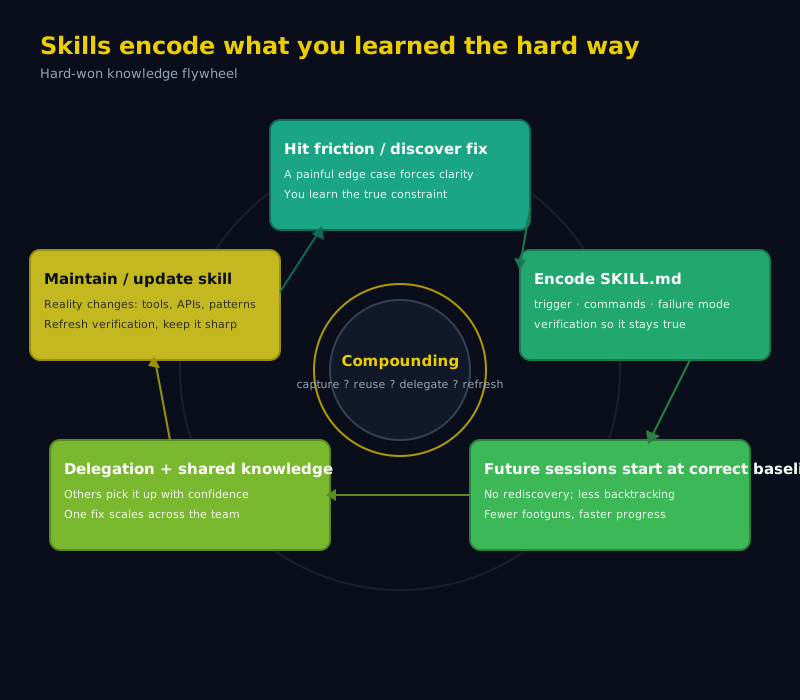
Thursday I finally got the join right—the one the docs gloss over. Monday Claude suggested the wrong table again because the winning pattern lived only in last week’s transcript. I was paying for the same debugging tax every time the calendar turned.
A skill is where that tax stops: a SKILL.md with a trigger, the commands that actually work, failure modes with consequences named, and a verification sniff test. Load it once when the situation matches; the session starts from the baseline I already bought.
What makes a strong skill #
Four obligations:
- A real trigger — the exact situation that earns loading this skill, not “sometimes useful”
- What to actually run — commands, endpoints, config. Secrets excluded, everything else explicit
- What I’ve burned time on — the failure mode you’ll hit if you skip a step. Name the consequence, not only the slip
- A verification pass — row count check, version sniff test, a known-good output to compare against
A strong skill reads like a hallway aside: use curl for this API; the CLI is broken — one sentence, one day saved.
Why skills compound #
Every session that starts from the right baseline compounds. By the third run I’ve saved the setup time and the debugging I’d spend re-learning the edge case.
Skills also make delegation possible. When I hand off a task to a subagent or a colleague’s Claude session, the skill carries the institutional knowledge with it. The receiver doesn’t need my debugging history; they need the distilled result of it.
The maintenance cost is real #
A skill that falls out of sync with the tool it describes is worse than no skill at all — it gives false confidence. When the procedure changes, both the skill and any playbook that references it need to move. I treat skill maintenance as ops, not garnish. A broken skill is an active hazard.
Where I’d start #
I pick the thing I’ve explained to Claude three times this week. I write it down as a SKILL.md with a trigger, the procedure, and the failure mode I keep hitting—that’s the first skill. Step-by-step: Build your first skill.