Run a literature review from your desk
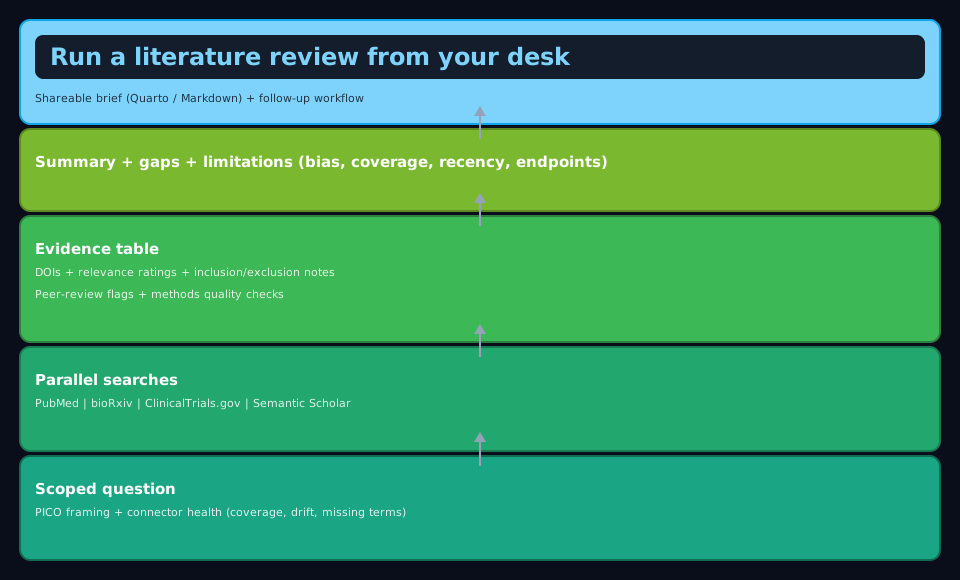
My first AI-assisted lit pass read beautifully until I clicked the DOIs. Two 404’d. One paper matched the title but contradicted the claim beside it. The model had written confident prose on vapor.
I fixed it with structure: scoped searches against the real indexes, DOIs and NCT IDs in the table, synthesis tied to what those queries actually returned—no more treating one chat thread as a literature database.
When I reach for this #
I need a structured survey of published research on a topic — for a project proposal, a competitive landscape review, or to answer a question like “what’s the current evidence for X?” and I need the answer to hold up under scrutiny.
What I need before starting #
- Claude Code with the
/literature-reviewskill installed - MCP connectors for PubMed and bioRxiv enabled (these come from the
claude.aiconnector set) - A scoped research question — not “tell me about cancer” but “what are the current Phase II+ trials combining X and Y in indication Z?”
What I do #
1. Scope the question #
The quality of the review depends entirely on the quality of the question. I write the research question as a single sentence with:
- The population or domain
- The intervention or method
- The outcome or comparison I care about
- A time window if relevant
Example: “What published evidence exists for NRF2 pathway modulation as a therapeutic strategy in neurodegeneration, published 2020–2026?”
2. Launch the review #
/literature-review
The skill asks clarifying questions about scope, then dispatches parallel searches across:
- PubMed — peer-reviewed published literature
- bioRxiv/medRxiv — preprints (not peer-reviewed, but often months ahead of publication)
- ClinicalTrials.gov — active and completed trials
- Semantic Scholar — citation network and related papers
Each source is searched by a separate subagent running in parallel. The searches complete in 2-3 minutes total.
3. Review the synthesis #
The skill produces a structured output:
- Summary — key findings across all sources, with source counts
- Evidence table — each finding with its source, DOI/NCT ID, date, and relevance rating
- Gaps — what the search didn’t find, or areas where evidence is thin
- Methodology notes — search terms used, databases queried, date ranges
Every citation links to a real DOI or trial ID. I can click through and verify.
4. Refine if needed #
Too broad — tighten terms, indication, or time window, then rerun.
Too narrow — relax one constraint at a time so the search can breathe.
Cadence — parallel searches keep each iteration in minutes, not afternoons.
What goes wrong #
- Question too broad — “what’s known about inflammation” returns hundreds of results with no useful synthesis. Narrow to a specific mechanism, indication, or time window
- Preprint bias — bioRxiv results aren’t peer-reviewed. The synthesis notes which sources are preprints, but I still flag them separately when citing in formal documents
- Missing databases — the skill searches the major life sciences databases. For chemistry-specific literature (reaction databases, patent searches), I supplement with targeted searches
- Connector issues — if a database search fails silently, the synthesis may be incomplete. Check the methodology notes to confirm all databases were actually queried
Notes #
Deep read — upload short-listed PDFs to NotebookLM for source-grounded Q&A on methods. This playbook finds candidates; NotebookLM is where I do close reading on the full text.
Share-out — export synthesis to Quarto (or similar) so the evidence table ships as a sortable artifact:
- Posit Connect
- internal static hosting
- a private GitHub Pages branch
Match whatever surface your org treats as the living report home.