Parallel research with subagents
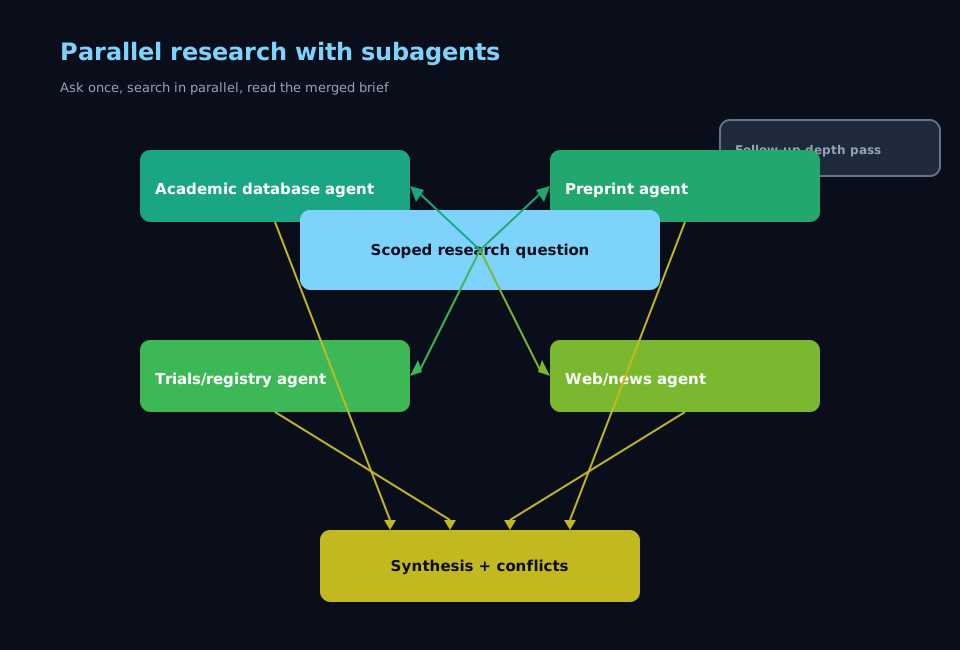
One biomarker question cost an hour in serial chat: search, open PDF, lose the tab, search again, wonder which hit was newer. /research replaced that stack with a parallel wave—literature, preprints, open web, registries—then a synthesizer that merged overlaps and flagged conflicts before I touched raw logs. Same clock time, wider terrain, one artifact to cite.
When I reach for this #
The question spans more than one source type. Or I already know serial “search, read, search again” burns time. Or I want a single artifact with sections I can cite instead of a scroll of chat.
What I need before starting #
- Claude Code with the
/researchskill installed (or equivalent workflow you use) - A research question stated in one or two sentences — not a whole brief yet
- Optional: a
--typehint if the skill supports skipping clarification (explore,technical,internal,quick, etc.)
What I do #
The /research skill clarifies scope, dispatches parallel researcher subagents, waits for all of them, then runs a synthesizer that merges overlaps and flags conflicts.
1. State the question plainly #
Write what you need decided or summarized. Include constraints: population, timeframe, geography, or “peer-reviewed only” if that matters. Vague questions get vague parallel passes; each subagent will interpret gaps differently.
2. Answer the scope pass honestly #
The skill usually asks what kind of evidence you want. Internal-only work routes differently from open-web exploration. Picking the wrong lane wastes a wave of searches.
3. Let the parallel wave run #
Typically several researchers fire: academic indexes, preprint servers, general web, and sometimes trial or registry search. They work independently. Duplication across agents is fine; synthesis is where duplicates collapse.
4. Read synthesis before diving into raw logs #
The synthesizer’s job is a merged view — claims, disagreements, gaps. Use the per-agent traces when you need a primary source or to verify a bold statement.
5. Drill down in a follow-up session #
Parallel research gives breadth. Depth still comes from a focused second pass on the two papers or datasets that actually matter.
What goes wrong #
- Over-broad questions — every agent returns a shallow skim. Fix: narrow the question or add must-include terms before re-running.
- Ignoring conflicts — two sources disagree and the synthesis flags it, but you only read the executive summary. Fix: open the conflicting sources; synthesis is a map, not a verdict.
- Stale or paywalled gaps — open web agents find abstracts; full text may sit behind access you don’t have. Fix: note “could not verify full methods” in your own notes.
- Skipping the type hint — you know you want a quick scan but sit through the full interview. Fix: pass
--type quick(or your skill’s equivalent) when supported.
Notes #
Parallel research costs more tokens than one lazy search. The trade is coverage and structure. For a yes/no with one authoritative doc, a single targeted query still wins.
If your installation names the skill differently, look for the workflow that says it dispatches multiple researchers and blocks until all return — same pattern, different label.